
Valve material selection is usually presented as a corrosion question, and corrosion is indeed part of it. But in practice the material decision is dominated by three constraints that interact: the chemistry of the medium, the temperature of service, and the mechanical duty the valve has to survive. A grade chosen purely to resist the medium can still fail within a season if it cannot carry the temperature, and a grade chosen for temperature can fail if nobody checked what the process fluid does to it. This article sets out a comparison method that accounts for all three, using the material combinations actually offered across a standard valve range.
The Materials and What Each One Is For
The valve range used here covers metals, a cast steel, and a family of engineering plastics, and each occupies a distinct position. Treating them as a single ranking from cheap to expensive obscures the fact that the correct choice is frequently the middle one.
| Material | Chemistry | Primary reason to choose it | Principal limit |
|---|---|---|---|
| 304 stainless steel | Austenitic Cr-Ni | General water, air, oil and food-grade service; excellent formability | Chloride pitting; not for aggressive chlorides |
| 316 stainless steel | 304 plus molybdenum | Improved chloride and chemical resistance | Higher cost than 304 for equivalent mechanical duty |
| 316L stainless steel | 316 with low carbon | Weldability without sensitisation; pharma and sanitary service | Lower strength than 316 at elevated temperature |
| WCB cast steel | Carbon steel casting | Strength and cost efficiency in large sizes | Corrodes readily; not hygienic |
| CF8 / CF8M | Cast 304 / cast 316 equivalents | Cast valve bodies with stainless corrosion resistance | Cast porosity requires sound castings and inspection |
| Grey iron / ductile iron | Ferrous casting | Large-diameter water and utility lines; low cost | Corrodes; ductile iron preferred where shock loading occurs |
| UPVC / CPVC | Chlorinated polyvinyl chloride | Strong acids, bases and saline solutions; low cost; lightweight | Temperature limited; not for solvents that attack PVC |
| PP | Polypropylene | Broad chemical resistance including many solvents | Lower pressure capability than metals |
| PVDF | Polyvinylidene fluoride | Highest temperature and chemical resistance in the plastic family | Highest plastic cost |
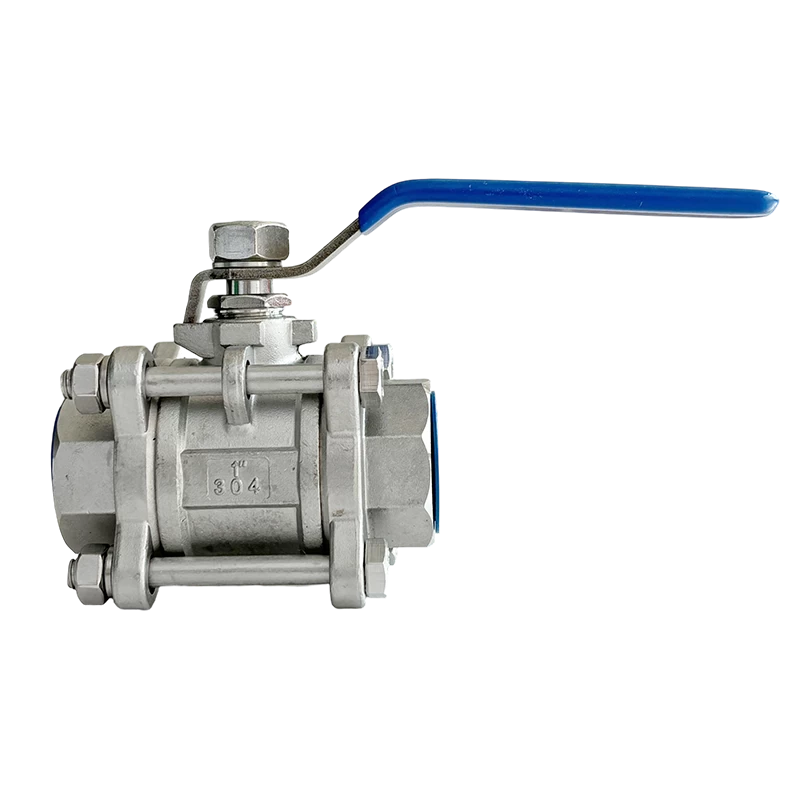
The distinction between 304 and 316 is the single most consequential choice in this table, and it turns on molybdenum. Adding molybdenum to the austenitic structure markedly improves resistance to chloride pitting and crevice corrosion. For town water, air, nitrogen and neutral oils, 304 is entirely adequate — it is the material used in the manual threaded ball valve (DN11–94, PN1.6 MPa, 304/316 body, ball and 304 stem, −10~120°C, PTFE seat, two-piece and three-piece patterns) and in the electric miniature 304 ball valve (DN8–25). Move the same valve into a chloride-bearing process or a coastal environment, and 316 or 316L becomes the specification, which is why the stainless steel stop valve (DN15–200, PN1.6–6.0 MPa, model J41W-16P) is offered across all three grades rather than in a single one.
Temperature as the Narrowing Constraint
Temperature narrows the material list faster than chemistry usually does, and it is the constraint most often overlooked because the valve body and the valve seat have different ceilings. Across this range the usable temperature windows separate clearly:
| Product / construction | Temperature range | Governing element |
|---|---|---|
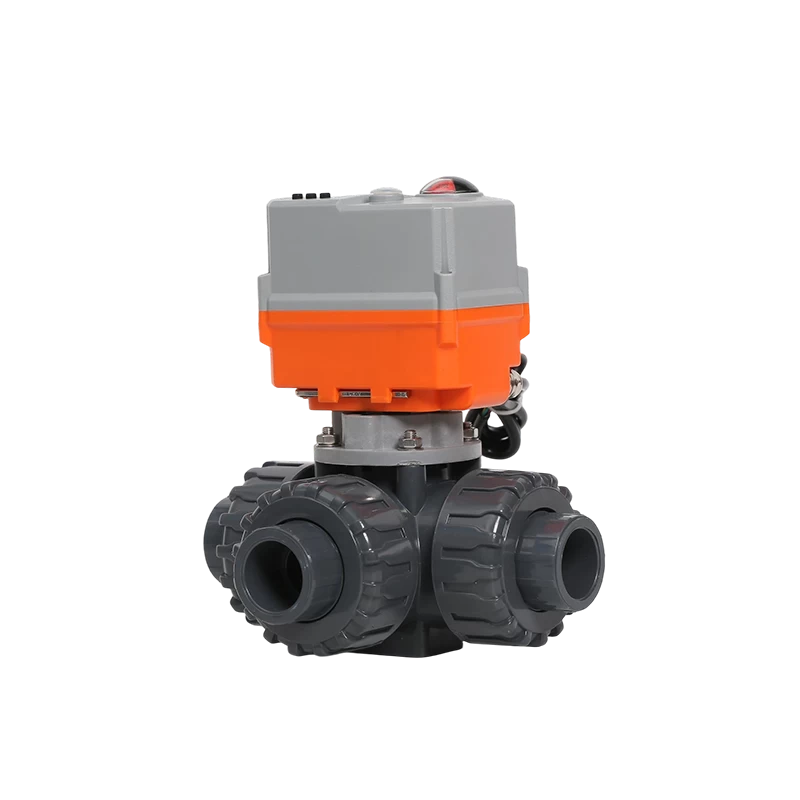
| Electric PVC three-way ball valve | 0~55°C | UPVC/CPVC/PP/PVDF body and PTFE/EPDM/FKM seat |
| Electric miniature 304 ball valve | −20~80°C | PTFE seat at ambient; PPL or metal seat for higher temperature |
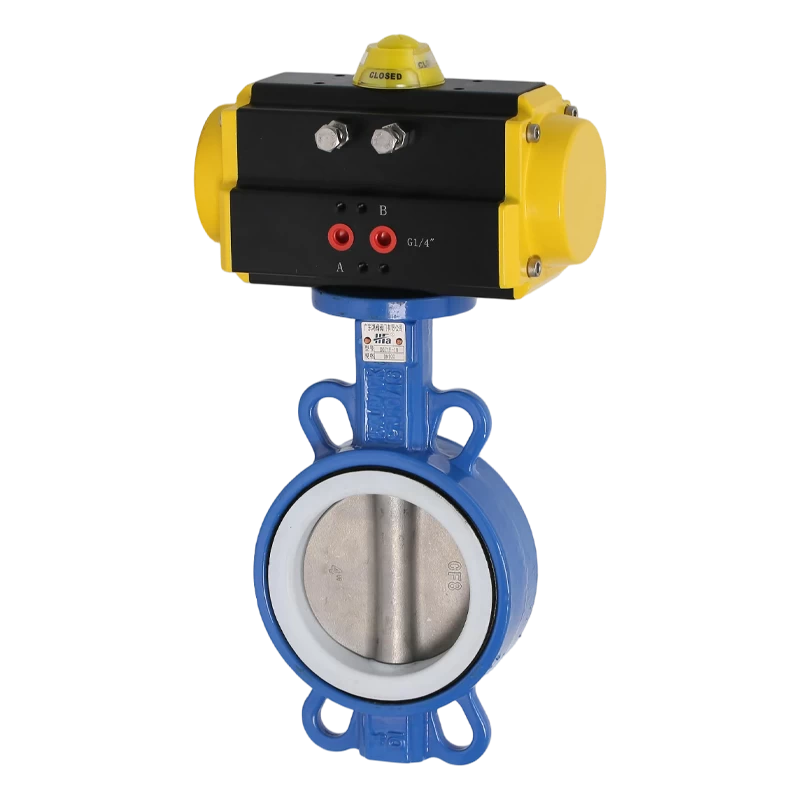
| Electric wafer-type butterfly valve | ≤80°C | PTFE seat as standard; PPL or metal seat as option |
| Manual threaded ball valve | −10~120°C | PTFE seat |
| Manual latching butterfly valve | −10~120°C | NBR standard seat; EPDM or PTFE as alternatives |
| Pneumatic SS fluoroplastic butterfly valve | −20~120°C | EPDM/NBR/PTFE seat |
| Stainless steel stop valve | −10~150°C | All-metal body and disc; no polymer seat in the flow path |
| Sanitary electric ball valve | −20~180°C | PTFE seat with 304/316/316L body |
| Pneumatic flanged ball valve | −20~200°C | PTFE/RPTFE/PPL/PEEK seat selected against the temperature |
| Stepping wedge gate valve with concealed stem | −10~200°C | Grey or ductile iron body with brass or stainless stem |
Two patterns in that table are worth noting. First, the high-temperature entries are not simply the ones with metal bodies — the stainless steel stop valve reaches 150°C because its sealing is metal-to-metal and there is no elastomer to soften, while a stainless-bodied butterfly valve with a PTFE seat stops at 80°C. The body material sets corrosion resistance; the seat material sets the temperature ceiling. Second, the lowest ceiling in the range belongs to the plastic valve at 0~55°C, which is the price of its chemical resistance. A process at 70°C in an aggressive acid cannot be served by UPVC at all, and the answer becomes PVDF or a lined metal valve — a different procurement category, not a different size of the same product.
Matching Material to Medium
With the ceilings established, the medium comparison becomes tractable. The applicable-medium statements in a specification are the fastest route to a shortlist, and they are worth reading literally rather than as marketing.
- Potable and process water, sewage, seawater: 304 or 316 stainless, ductile iron, or the soft-sealed butterfly family. Seawater is the discriminator — it removes 304 from consideration in favour of 316 or a non-metallic body.
- Weak acids and weak alkalis: the acid-resistant plastics, or stainless where the concentration and temperature are mild.
- Strong acids, bases, saline solutions: UPVC, CPVC, PP or PVDF. The electric PVC three-way ball valve (DN15–50, PN1.0–1.6 MPa, UPVC/CPVC/PP/PVDF body and plug, PTFE/EPDM/FKM seat, double-ended live joint, 0~55°C) is specified for corrosive, low-viscosity fluids without hard particles.
- Steam: metal-seated or high-temperature polymer seats, with the body rated for the temperature. The stainless steel stop valve explicitly lists steam among its media.
- Food, beverage, dairy, pharmaceutical: 304, 316 or 316L with PTFE sealing, and connections that can be cleaned. The sanitary electric ball valve uses a clamp (Tri-clamp) connection with 304/316/316L body and PTFE seal for exactly this reason, and its stated applications include beverage, beer, dairy, soy sauce blending, WFI and purified water, CIP/SIP circuits, cosmetics and fermenter feeding.
- Nitric acid and corrosive liquids: the stainless grades are named for this service on the stop valve specification, which lists water, steam, oil products and nitric acid corrosive liquids.
One further distinction matters for hygiene-critical lines. A cast stainless body (CF8 or CF8M) and a wrought or bar-stock stainless body can have identical chemistry on paper while differing in surface condition and internal soundness. Where cleanability or product contact is the concern, the connection type and surface finish deserve as much attention as the grade designation, because a dead leg or an unfinished internal surface harbours product regardless of what alloy it is made from.
Where Material Choice Interacts with Actuation
Material and actuation decisions are usually made by different people at different times, and the interface between them is where specification errors accumulate.
- Stem material sets the torque and wear picture. Valve stems in this range include 2Cr13 martensitic stainless, F304 and F316, brass, and 304 stainless. A brass stem in a high-cycle automated application wears differently from a stainless one, and the actuator sizing assumes a stem condition.
- Body material sets the actuator mounting. A plastic-bodied valve has different thread engagement and stiffness from a cast steel one, so the actuator bracket and the tightening torque are not interchangeable.
- Temperature affects both the seat and the actuator. A valve rated to 200°C may have a seat that survives it and an actuator whose internal seals do not, unless the actuator is specified for the radiated heat. High-temperature service frequently requires either a mounting bracket that distances the actuator or an actuator with a higher temperature rating.
- Pressure class must match the piping, not the pump. Nominal pressure in this range varies from PN1.0 to PN6.0 MPa. Selecting a lower class because the operating pressure is low ignores water hammer, which can produce transient pressures several times the steady-state value.
A practical specification therefore lists medium, concentration, temperature, pressure class, cycle frequency and cleaning regime together, and only then reads off a body material, a seat material and an actuation method. Doing it in that order produces a valve that survives its service. Doing it in the reverse order — starting from a preferred product and checking afterwards whether it fits — is how installations acquire valves that pass their factory test and fail their first year.